December 8, 2025
“I Learned Japanese from Demon Slayer!” — Half Their Salary Goes Home, and They Still Choose Japan
「鬼滅の刃で日本語を覚えた!」給料の半分は母国へ──それでも日本を選ぶ外国人介護士のリアル
By Yu Taguchi / 田口ゆう
English translation of a published feature, originally in Japanese, December 2025.
Interview, writing, and translation by Yu Taguchi.
Japan’s working-age population has shrunk from roughly 87 million in 1995 to approximately 74 million in 2023, and the number of births fell below 700,000 in 2024 (a record-low total fertility rate of 1.15). The government has proclaimed “unprecedented measures against the declining birthrate,” but results remain elusive. According to Teikoku Databank, labor-shortage bankruptcies hit 342 in 2024, up 31.5% year-on-year. The caregiving sector has been hit hardest: in the first half of 2024, nursing care provider bankruptcies reached a record 81 cases, with over 60% citing “labor shortages” as the cause (Tokyo Shoko Research).
The Ministry of Health, Labour and Welfare estimates that Japan will need approximately 2.8 million care workers by 2040, but currently faces a shortfall of 690,000. Foreign labor is “an indispensable piece of the puzzle.” We sat down with four foreign technical intern trainees working in caregiving facilities to hear about their realities: learning Japanese, financial burdens, and workplace relationships.
Roundtable Participants
- A — Thailand, female, 20s, 5th year in Japan, group home
- B — Nepal, female, 40s, 3rd year in Japan, nursing home
- C — Philippines, female, 30s, 3rd year in Japan, nursing home
- D — China, male, 20s, 5th year in Japan, disability support facility
Names and certain details have been changed to protect privacy.
“I Learned ‘meshiagarimasu’ from the Hashira Meeting in Demon Slayer!”
— How did you learn Japanese?
A: I studied from Japanese anime like Demon Slayer, Attack on Titan, Chainsaw Man, and Blue Lock. Demon Slayer is especially useful because it’s full of keigo [formal/honorific Japanese]. In the Hashira Meeting scenes — where the Demon Slayer Corps’ top-ranked warriors hold a formal council before their leader — the Hashira speak to Ubuyashiki-san using keigo, so it’s very educational (laughs). Phrases like “meshiagarimasu” [“please eat,” honorific] and “goran ni natte kudasai” [“please look,” honorific] are directly useful in caregiving. At first, Japanese was so hard I wanted to quit. But the Japanese staff and the residents at my facility were so kind that I kept going. When I come across kanji I don’t know, I look them up on a smartphone app.
Everyone: A lot of people study from anime, right?
B: I learned by asking the residents over and over and having them teach me words. I love talking with the 102-year-old resident at our nursing home. She tells me so many stories about the war and the old days. She remembered my name, and now when she sees me, she greets me with “Namaste.” That makes me so happy.
A: A Thai acquaintance of mine grew up watching older anime like NARUTO. He worked at a press factory for three years, then transferred to a special nursing home because he wanted to learn Japanese. He learned through communicating with residents and Japanese staff. At the press factory, there were few opportunities to use Japanese — it was mostly instructions through interpreters.
C: I learned Japanese by listening to songs and conversations on YouTube.
D: I write emails in Chinese, then use ChatGPT to convert them into Japanese keigo. Chinese honorifics aren’t as complex as Japanese, so without ChatGPT, it would be very difficult. Shift handovers are done on a tablet, so I’ve gotten used to that.
Eight Siblings Plus Parents to Support, Medical Bills Out of Pocket — A Filipino Caregiver’s Reality
— Do you face financial burdens?
C: I send about half my salary home to my family of ten — eight siblings and both parents. My younger sisters’ tuition and my mother’s stroke have made the medical costs enormous. The Philippines has a medical insurance system, but it barely functions in practice, so almost everything is out of pocket. My salary is around 240,000 to 250,000 yen, and a bit more with night shifts. Sending money home is part of the culture — it’s normal to work for your parents and siblings. But back home, only the wealthy can afford care services. I can provide care for elderly Japanese people, but I can’t care for my own parents.
Everyone: Wow! You send that much home?!
B: I have two children in university — the older one is 23 and the younger is 20. I send between half to two-thirds of my salary home for their tuition and living expenses. My salary is around 250,000 to 300,000 yen with night shifts. I talk to my children on the phone every day. When you send more than half your salary home, your own life becomes very tight.
Everyone: That much?! You earn that much?
A: Japan’s cost of living and rent are high. Without night shifts, the salary isn’t enough, and sending money home is difficult. My parents back home tell me to prioritize my own life and send money only if there’s extra. Regular remittances aren’t mandatory in our culture. I haven’t sent much lately, but I send when there’s a need. It’s not a fixed amount.
A 102-Year-Old Says “Namaste!” — When Residents Become “Japanese Language Teachers”
— How are workplace relationships?
C: Language barriers and cultural differences sometimes lead to misunderstandings. But because I need to send money home for my family, I can’t just quit easily. At work, there are times when it’s hard to be understood, and I feel lonely.
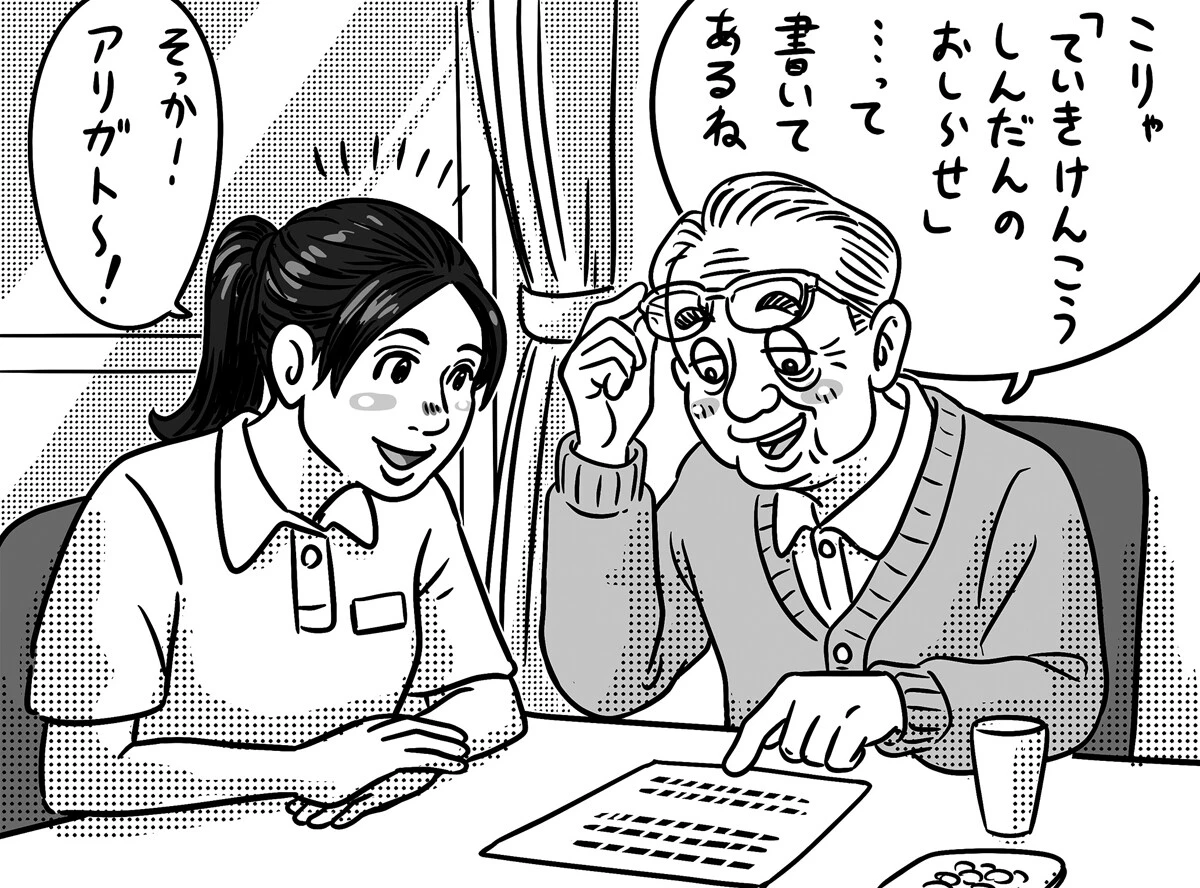
A: At my workplace, the Japanese staff and residents are kind. It’s challenging but enjoyable. Residents ask me things like “Where are you going today?” or explain the meaning of kanji to me. Some Japanese staff say, “If there’s anything you’re not good at, just ask.”
B: Back in Hokkaido, I wanted to quit. But now the workplace support is generous, and I enjoy it. Learning together with the residents gives me a sense of purpose. Residents say things like, “Was the typhoon okay?” or “Your country is far away, don’t you get lonely?” It makes me happy that they care.
Column
Why the Disappearance Rate Among Foreign Caregivers Is So Low
The number of foreign technical intern trainees who go missing has been increasing year after year, reaching a record 9,753 in 2023. However, the disappearance rate among caregiving trainees remains extremely low compared to other industries — estimated at just 0.1% of all disappearances.
Shinya Kondo, principal of Musashi Care Academy, which accepts many foreign trainees, points out:
“We teach caregiving trainees, and I’ve never heard of any going missing. Some of our students switched from press factory work to caregiving because they wanted to learn Japanese.”
“The ones who disappear are trainees in industries like factories and agriculture, where there’s little communication with Japanese people. When you can communicate in Japanese and have human relationships, you don’t think about doing bad things. Communication is essential in caregiving work. That difference is what affects the low disappearance rate and fewer troubles with Japanese people.”
The Rewards and Challenges of Caregiving
— Isn’t caregiving work difficult?
C: Toileting assistance, bathing support, and physical care were very hard at first. I had a strong resistance to touching private areas. But as I got used to it, that faded.
D: I work at an NPO, so the pay isn’t great, but the sense of purpose is huge. Our workshop is small — I’m the only full-time staff, working with part-time foreign employees as a team. Being short-staffed makes coordination as a manager tough, but I’m glad I switched from design work. I find real meaning in disability support. The big difference between China and Japan is that Japan has much greater social acceptance of people with disabilities and better public facility access. In China, there’s a lack of understanding, and opportunities for social participation by people with disabilities are limited.
A: Because my Japanese was still developing, there were many times I couldn’t understand what residents said and got scolded. But through residents teaching me Japanese and culture, trust was built. I also teach them about my home country in return.
— People with dementia often lose self-esteem as their abilities decline. It sounds like teaching Japanese to the trainees actually gives the elderly residents a sense of purpose too.
B: Residents with dementia ask me the same things over and over, but that actually helps me practice Japanese. When someone says “thank you,” it makes me feel like this job is worth doing.
“I Want to Bring My Children to Japan and Work Together” — Why They Still Choose Japan
— Do you want to continue working in Japan?
A: I want to complete the practical training certification and get my Certified Care Worker qualification, then continue working in Japan. Japan is safe and easy to live in.
B: I’m also going to take the Certified Care Worker exam. My child is studying IT. I want to put them through university and then work together in Japan.
C: I want to advance my career too. I already have a caregiving qualification from the Philippines, and I plan to take the Certified Care Worker exam in Japan. Sending money home is hard, but I do my best for my family. With the qualification, I could also work in Australia or New Zealand, but for now I want to stay in Japan. When I go home, agents from other countries are sometimes waiting at the airport with signs offering job conditions.
D: Japan’s care system and disability welfare are at a high level, and there’s so much to learn. In three years, I’m aiming to get my Service Management Supervisor certification.
Home-Visit Care Opens to Foreign Workers in April 2025 — The Key to Coexistence Is “Human Connection”
The participants in this roundtable primarily work in elderly and disability care facilities. Starting April 2025, foreign nationals with specific residency qualifications are officially permitted to work in home-visit care — a sector facing acute labor shortages.
In home-visit care, one-on-one communication becomes even more critical. While some voices argue that the benefits of working in Japan have diminished for foreign workers, these individuals — who send half their salary home and still say “I want to keep working in Japan” — tell a different story. The key to coexistence is human relationships and communication. As the remarkably low disappearance rate suggests, what holds people together may simply be connection.
— Interview, writing, and translation by Yu Taguchi.