December 2025
The Tokyo University Graduate Living in a Hoarder House
Part 2 of 2 — From a Boys’ School to Women’s Clothes: A Childhood, a Mother, and the Awakening of Mizuki, 29
By Yu Taguchi / 田口ゆう
Originally published in Bunshun Online (Japanese), 2025. Original Japanese article. English translation by the author.
Mizuki, 29, has appeared in Japanese media as “the Tokyo University graduate who lives in a hoarder house” — a label born from the contrast between their overflowing apartment and the delicate femininity of their on-camera presence. They studied in the Faculty of Science at the University of Tokyo, and during their undergraduate years began to discover women’s clothing and makeup. The gap between the room and the person has a way of catching the eye.
Born the eldest son into an elite family — both parents are graduates of the University of Tokyo — Mizuki attended a six-year combined junior- and senior-high school before going on to the same university themselves. From very early on, however, the marriage was strained, and Mizuki grew up believing they were not loved. Today, Mizuki describes their mother flatly: “She’s a sponsor, nothing more.” We asked them about their upbringing, and about the moment they began to find their way into women’s clothes and makeup.
(Part 2 of 2. Read Part 1 here.)
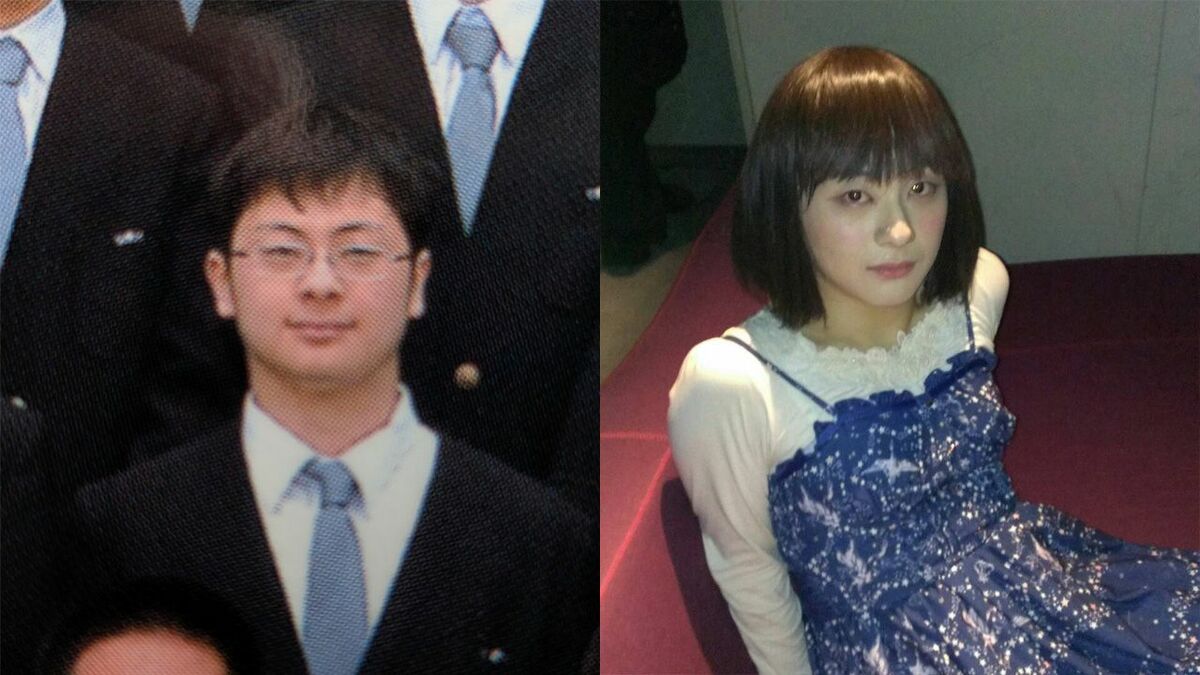
[Photograph: Mizuki as a high-school student, the only child of two University of Tokyo graduates, who later went on to the same university themselves. They began to wear women’s clothes and makeup as an undergraduate, and today live with the nickname “the cute girl who lives in a hoarder house.” Photo provided by the subject and © Keiji Ishikawa / Bungeishunjū. Not reproduced here due to copyright.]
The House Where the Fights Never Stopped
— You’ve appeared in the media as “the Tokyo University graduate who lives in a hoarder house.” What kind of family did you grow up in, originally?
Mizuki: I was born in Arakawa Ward, Tokyo. Both my parents graduated from the University of Tokyo, and from what I’ve heard, they were in the same research lab. Both of them wanted to become researchers. But when my mother got pregnant with me, they were still students, and she had to take a job in order to support a child. My father had apparently promised her he’d take a job too — but in the end, he stayed on the research track. Breaking that promise, I gather, was something my mother never forgave.
— What was the relationship between your parents like, when you look back on your childhood?
Mizuki: Not good. My memories are mostly of them fighting. Verbal arguments, of course, but also things like my mother tearing up sheets of paper and scattering them around the whole house.
[Photograph © Keiji Ishikawa / Bungeishunjū. Not reproduced here.]
— Was it because she still resented him for breaking the promise?
Mizuki: That was probably part of it, but I think there were many reasons. The one I remember most clearly is the time my mother took cash out of my father’s wallet. The two of them stood in front of the house in a screaming match. Mostly, I think, my mother would lash out emotionally, and my father would respond with logic. In the end, my parents began living separately when I started junior high, and they divorced when I was in my third year. My younger sister and I went with my mother. From that point on, with no one to rein her in, her temper grew worse. Sometimes it reached me, too.
— Did your mother ever hit you?
Mizuki: She did slap me. But I don’t have any memory of being beaten badly or anything like that.
Sponsor, Nothing More
— Is there an exchange with your mother that has stayed with you in particular?
Mizuki: When I was in junior high, my mother once got it into her head that I was being bullied at school, and she came at me with extremely harsh words. I actually wasn’t being bullied at all. But she told me, “I’m not paying tuition for you to come home bullied,” and she was furious. It wasn’t worry about me. The first thing she felt was anger: “I’m paying high tuition, and you come home bullied?” That really disappointed me. She had already been saying things like, “I’m paying for you, so do as I say,” or, “If your grades drop, I won’t keep paying tuition.” I had vaguely felt, “I’m not being treated as someone who matters” — and in that moment, the vague feeling hardened into certainty. Ah, I thought, this person only sees me as an investment. From around then, I started thinking of her as a sponsor, nothing more. In order to keep food, clothing, and shelter coming, I deliberately aimed for the standing within school, the grades, and the school placements that she wanted from me.
[Photograph: Mizuki currently lives in a one-room apartment with rent of ¥38,000 a month. © Keiji Ishikawa / Bungeishunjū. Not reproduced here.]
— Was that also why you aimed for the University of Tokyo?
Mizuki: A little bit, but mostly I aimed for the University of Tokyo because I wanted to be a researcher. My parents had both been in research, and I’d loved chemistry for a long time. In the end, I enrolled in the Faculty of Science.
— Were your grades always strong?
Mizuki: In elementary school, my grades were good, and I think “being smarter than the people around me” became a kind of identity for me. At the cram school I attended to prepare for the junior high entrance exams, I held my own. Still, I don’t really remember being praised at home. I missed my first-choice school in the entrance exams and ended up at a six-year boys’ school. By the time I graduated, I was probably in the top third of my class.
— Did you have to grind yourself down to get into the University of Tokyo?
Mizuki: From my first year of junior high I attended Tetsuryokukai — a cram school that specializes in University of Tokyo prep — and there was so much homework I’d often be at it until past midnight. But I don’t really remember feeling cornered, or driving myself into the ground. At school as well as the cram school, I just quietly worked through the assignments I was given, and the result happened to be that I got in.
“I’d Had a Chest Since Junior High”: Discovering Women’s Clothes and Makeup at University
— What was the University of Tokyo like, once you got there?
Mizuki: I went into the Faculty of Science, but actually my mother had told me to apply to the Faculty of Medicine. I had no intention of becoming a doctor, and Medicine felt like a fairly small community — about a hundred students per class. I didn’t like the idea of that. I wanted to meet a wider variety of people, and I’m genuinely glad I ended up in Science. Once I was at the University of Tokyo, I was finally able to become the person I’d wanted to be for a long time.
[Photograph withheld at the subject’s request.]
— How so, specifically?
Mizuki: Ever since I was little, I disliked having my gender decided for me by other people. I tended to play with girls more often than boys. Sometimes I’d see a friend’s outfit and think, I’d love to try wearing something like that — but I could never quite take the first step. At the University of Tokyo, though, there were people who dressed and expressed themselves freely, without being bound by gender. That gave me the push I needed, and around my second year, I started wearing women’s clothes. At first I bought things from Uniqlo and Shimamura, and a senior in the cosplay-dance circle I was in at the time taught me how to do makeup.
— When your appearance changed so suddenly, how did people around you react?
Mizuki: At first they were surprised. But I figured if I just kept doing it, they’d come to accept it — and that’s what happened.
— Your skin is beautiful, too. There’s no real sense of incongruity.
Mizuki: People do tell me my skin is good. They ask, “What’s your skincare routine?” But honestly, all I do is wear sunscreen. I always struggle to answer (laughs). Beyond that, I’ve always had a soft, round build. By around junior high, I had a kind of chest, and these days I wear bras.
Don’t Call It Crossdressing
— You stream your meals every day. What sorts of comments do you get most often?
Mizuki: Most people are kind. Being told “You’re cute” over and over is something I really appreciate.
— On the other hand, are there words that have hurt you?
Mizuki: I really, really hate being called crossdressing. As I said earlier, I dislike having my gender decided for me. If I had to put it into words, it isn’t so much that I want to be seen as a woman — it’s closer to I don’t want to be seen as a man. That said, I do want to be seen as “sexy” or “erotic.” Being looked at sexually doesn’t bother me — in fact, I welcome it. I’ve even tried doing my streams in a more sexy direction at one point: photographs and videos in revealing, sexy outfits.
[Photograph: Mizuki sometimes receives premium ingredients — Shine Muscat grapes, prime bluefin tuna — from viewers watching the stream. © Keiji Ishikawa / Bungeishunjū. Not reproduced here.]
— What about your views on love?
Mizuki: I’ve dated men, but it never quite fit, so I’d think, “Maybe I should date women instead.” Then after dating women — I came to think that has its own difficulties, too. More than gender, I think a lot of it depends on the person. But fundamentally, I don’t want to belong to just one person. I want to meet many people. I want to be liked by many. Maybe what runs strongest in me is the wish to be more like an idol.
This concludes the two-part interview with Mizuki, 29.
A Note from the Author
Companion essay to “The Tokyo University Graduate Living in a Hoarder House” (Parts 1 & 2).
The University of Tokyo — commonly known in Japan as Todai — sits at the apex of the country’s higher education system. It is the institution that produces Japan’s bureaucrats, politicians, doctors, and researchers; the credential that signifies, more than any other, “elite” in this society. When I learned that a young graduate of this university was living in a hoarder house barely large enough to lie down in, I was drawn to the contradiction. I wanted to meet the person inside it.
The person I met bore no resemblance to the aggressive “monster” the public tends to imagine when it hears the phrase “hoarder house resident.” Mizuki was intelligent, easy to talk with, and possessed a charm all their own — our conversation drifted naturally onto cosmetics. The delicate distance Mizuki articulates in this interview — not so much wanting to be seen as a woman, but rather not wanting to be seen as a man — was visible in their very bearing. In my eyes, Mizuki was simply a fascinating person who happened to live calmly in a messy room.
A hoarder house, however, contains more than meets the eye. Beyond the cockroaches and the visible debris, the air itself carries mold spores and other invisible hazards. Mizuki said as much during our conversation: “I’m fine in here, but visitors get sick.” After about ninety minutes inside the apartment, my editor at Bunshun Online and I both fell ill the following day, and spent it in bed. Only Keiji Ishikawa, the photographer — who had completed his striking images in record time — walked away unscathed.
This article was later ranked fourth in Bunshun Online’s “Most-Read Articles of 2025: Influencer Category.” The reception has been generous toward both the writing and Ishikawa’s photographs, which were singled out for praise in their own right. Copyright prevents me from reproducing those photographs in this English translation. I hope readers will visit the original Bunshun Online article to see the world of Mizuki’s apartment as Ishikawa captured it — there are things a photograph does that words cannot.
— Yu Taguchi