English translation of a published news feature, originally in Japanese, 2024.
Reporting, writing, photographs, and translation by Yu Taguchi.
On May 23, 2024, the first oral arguments were held at the Tokyo District Court in a lawsuit brought by eleven Kurds, members of a Turkish ethnic minority living in and around Kawaguchi City, Saitama Prefecture. They were seeking five million yen in damages from a freelance journalist, alleging that his posts on X (formerly Twitter) had damaged their reputations. The plaintiffs’ attorney was Takuya Iwamoto (age 55) of Tokyo Akatsuki Law Office, located in Minami-Otsuka, Toshima Ward, Tokyo — a lawyer well-versed in discrimination cases. This article, based primarily on the interview with Iwamoto and supplemented by the author’s own on-the-ground reporting, asks whether the facts circulating on social media actually exist.
[Photo: Attorney Takuya Iwamoto (age 55) speaking while reviewing the voluminous printed case materials.]
“At the first oral arguments, the defendant described me as a ‘leftist lawyer,’ but I am a conservative. I took on this case to protect Japan’s national interest.”
Iwamoto wishes to distance himself from the left-wing sentimentalism of the “poor Kurds” variety. The defendant journalist began posting about Kurds on X in May 2023.
“Outlaws should be deported as outlaws. Anyone — not just Kurds — who violates Japanese law should be arrested. In fact, the Kurds who caused an accident by ramming a bus with their vehicle were deported to their home country. That is the job of the police. But to say that all Kurds in Japan are bad because some of them are outlaws is nothing more than racism. By enlarging the subject to ‘Kawaguchi’ and ‘Kurds,’ threat letters arrive from all over the country to the Japan Kurdish Cultural Association and to Kurds in Kawaguchi who are living through legitimate channels. How is this in Japan’s national interest?”
[Photo: A threat letter delivered to a Kurdish business owner. It reads: “PKK, get out.” The postmark is Fukuroi City, Shizuoka Prefecture — not Kawaguchi City. Name and address redacted.]
The Disinformation Spread on X
Iwamoto has carefully verified the facts behind the posts on X. On February 2, 2024, a member of the public posted: “BTW, the Kurdish brats who were dining-and-dashing and causing trouble at the Yoshinoya in Kamiaoki yesterday are the same kids who threw fireworks inside the AEON mall in Maekawa.” In response, an inquiry was made to Yoshinoya Co., Ltd., and the company formally replied that no such facts existed.
[Photo: The false post of February 2, 2024. As of May 29, 2024: 415,000 views, 2,915 reposts, 8,422 likes. Poster’s identifying details redacted.]
[Photo: The response from Yoshinoya Co., Ltd. Identifying details redacted.]
Such false posts exist in countless numbers, he says.
What On-Site Reporting Revealed
The Japan Kurdish Cultural Association and Kurds in Japan, responding to social media posts claiming that differences in lifestyle have caused friction with Japanese residents and that public safety has deteriorated because of Kurds, have been conducting regular nighttime patrols. The author covered the patrol of April 26, 2024, together with other journalists. It lasted approximately two hours.
[Photo: The nighttime patrol conducted by Kurds and Japanese volunteers.]
The author also visited the area around Warabi Station in Kawaguchi City on other days, both during the day and at night, and did not observe Kurds rampaging through the streets. On the day of the nighttime patrol coverage, television crews and other members of the press were also present. Kawaguchi City is currently drawing attention from the media, and many press members are visiting to report. If Kurds in Japan were repeatedly committing illegal acts under this media attention, it would be reported extensively.
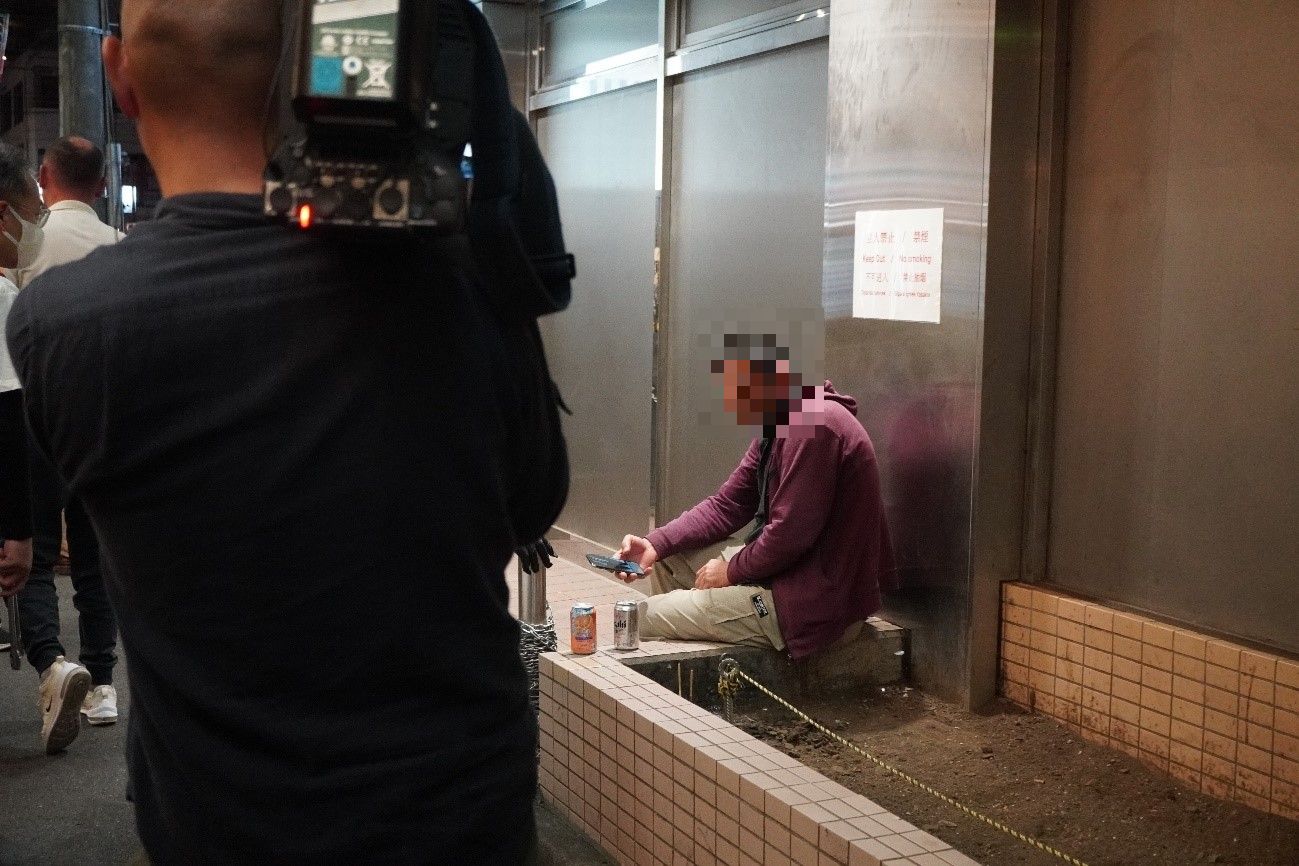
[Photo: A television crew also covering the patrol. A foreign man drinking on the sidewalk. Face of private subject digitally obscured.]
During the patrol, there was one foreign man drinking on the sidewalk; he was urged to return home, and that was the only incident. The streets were entirely peaceful. It should be noted that the area around Nishi-Kawaguchi has long had many pink-salon parlors and cannot be said to have ever been an especially safe area.
A journalist who accompanied the author stayed at a business hotel to observe the late-night situation. But what stood out, he reported, were not people of Middle Eastern background but East Asian foreigners — the district, he said, resembled a Chinatown. That journalist was harassed at an izakaya, but by a Japanese person. This is hardly surprising. Kawaguchi City’s foreign residents currently number approximately 40,000, or about 6.7 percent of the city’s population, but when one looks at the breakdown by nationality, Turkish nationals ranked sixth as of January 1, 2024. A small number of Kurds in Japan would hardly stand out. In fact, walking around Warabi Station at night, encounters with Turkish nationals were themselves rare.
The author took a taxi and asked the driver about the neighborhood. The driver, a Kawaguchi resident, replied: “Foreigner-related trouble is common, and it’s a nuisance.”
The Claim That There Is No Persecution of Kurds in Turkey
[Photo: Iwamoto speaking about the situation of Kurds in Turkey.]
Returning to Iwamoto’s account: on X, the claim that there is no persecution of Kurds in Turkey circulates widely. Is it true?
“There are such claims, but the peculiarities of Turkey’s ‘terrorist’ designation are also noted in the UK Home Office’s Country Policy and Information Note. Merely criticizing the country or the government can result in detention as a political prisoner. If that is not persecution, what is? If they return to their country, they will be unjustly imprisoned as political criminals.”
In Japan, the principle of legality that is taken for granted — the principle of modern constitutional law that requires any act to be deemed criminal, and any punishment imposed, only under a written law enacted democratically by a legislature in advance — appears, on this account, to be disregarded by the Turkish government, and doubt necessarily arises.
“Japan’s criteria for refugee recognition are extremely strict. So they have not been recognized as refugees, but if they return to their country, they are subject to persecution.”
The Kurds, called “the largest stateless people,” live in Turkey, Iran, Iraq, Syria and elsewhere, and in each location they face persecution as an ethnic minority. The United Kingdom, the United States, and other countries accept Kurds as refugees.
Racial Discrimination That Spreads When the Economy Worsens
“As background to why this kind of racial discrimination spreads, I think economic factors also play a part. On X, the story of a Kurdish outlaw riding a Ferrari is being circulated. The Japan Kurdish Cultural Association is aware of that individual as well. They are at their wits’ end. There may be a feeling that while Japanese people are living hard lives, it is outrageous that a Kurdish person is riding a Ferrari.”
At the time of the Great Kanto Earthquake, which occurred on September 1, 1923, the rumor that “Koreans had poisoned the wells” spread, and military personnel and citizens who believed it massacred Koreans. The spreading of groundless stories against a backdrop of unease and economic hardship also occurred one hundred years ago.
“People say that no measures are being taken, but the confirmed figures for detection of major theft crimes, penal-code offenses, and major crimes in Saitama Prefecture in fiscal 2023 were up year-on-year. Some turn this around and claim crime is rising, but a higher detection rate is proof that the police are functioning properly.”
It is not the case that the government is taking no measures. The amended Immigration Control Act, which includes provisions making third-time and subsequent refugee applications subject to deportation, took effect in June.
“Members of the Diet have amended the law, and the police are arresting criminals. Each is fulfilling its role. The amendment to the Immigration Control Act will certainly reduce fraudulent asylum seekers. Because the Japanese government operates an ambiguous system called provisional release — leaving foreigners who cannot legally work but can remain in Japan unattended — various problems arise. Such an ambiguous system should be changed. I am opposed to immigration policy. Because the Japanese government easily admits foreigners as cheap labor, problems such as the mafia-ization of Vietnamese residents are occurring.”
[Photo: Iwamoto reviewing the materials for the defamation lawsuit. Identifying details redacted.]
Of course, crime by Kurds in Japan is not zero. But it is not as though the facts circulating on social media exist. To ensure we never repeat the tragedies of a century ago, I want to stop and think before taking someone’s post at face value and sharing it.
— Reporting, writing, and translation by Yu Taguchi